Short answer: an FEC entertainment floor is budgeted by category, not by total. Interactive floor games are priced per square metre, VR attractions per machine, sports simulation per bay, and mirror mazes per project with no list price at all. Build the budget in four parts, each in its own unit, then reconcile the four against your floor area. A total quoted before that exercise is an estimate of somebody else’s venue.
This guide sets out each category’s published price basis, the areas they occupy, and a sequence for buying them, using our own September 2026 figures.
Why a single equipment budget never survives a quotation
The single-number approach fails for a structural reason rather than a dishonest one. A supplier who publishes a total range has to average across venues, and the average is dominated by floor area and by how many categories the operator chooses to install. An FEC with an interactive floor and a mirror maze and no VR shares almost nothing with one that runs six VR units as its anchor, yet both get called an FEC and both get folded into the same published range.
There is a second problem, and it is the one that costs money late. Three of the four categories are priced on a basis you can estimate before you talk to anyone, and the fourth is not. If you assume a per-unit price for the category that has none, your budget is wrong by an amount you will only discover after design work has started.
The practical fix is to budget in four lines rather than one total, each in the unit its category is actually sold in. Then check the four lines against two constraints that the totals conceal: the floor area they consume, and the timing of when each one starts earning. Both are covered below.
The four categories, and the four things they are priced by
An entertainment floor is not a list of machines. It is a mix of categories, and each category is sold on a different basis, which is why quotations that look comparable usually are not.
Two of those ranges are arithmetic: multiply the rate by your area and you have a budget line. One is a unit price you multiply by a machine count. And one is not a price at all, because a mirror maze has no list price.
That last point deserves emphasis, because it is where most first-pass budgets break. An interactive floor can be estimated from a drawing. A VR unit can be estimated from a catalogue.
A mirror maze cannot, because the panels are manufactured to the wall runs of your room, the route is planned around your entrance and exit positions, and the installation depends on your ceiling height, floor conditions and delivery route. A supplier who gives you a firm mirror maze price before seeing a floor plan is giving you a starting estimate, not a quotation.
What each category actually costs
Interactive LED floor games are the easiest to budget and the hardest to compare, because the per-square-metre rate spans a factor of three. A commercial system runs from about USD 800 to 2,500 per square metre depending on the LED tile specification, the accuracy of the sensing, the size of the game library and whether access control is included.
Those rates put our standard configurations in three bands. A small interactive zone of 10 to 15 square metres lands at roughly USD 8,000 to 15,000. A medium FEC installation of 20 to 40 square metres lands at USD 15,000 to 35,000. A large active gaming attraction of 50 square metres or more starts at USD 40,000 and runs past USD 100,000. The band you are in is decided by which venue type you are, not by which system you like.
VR is priced per machine, and the spread is wider than the floor games spread. Our units run from about USD 2,500 for an entry single-seat unit to USD 30,000 or more for a large-format attraction, and the number is set by the format rather than by the brand.
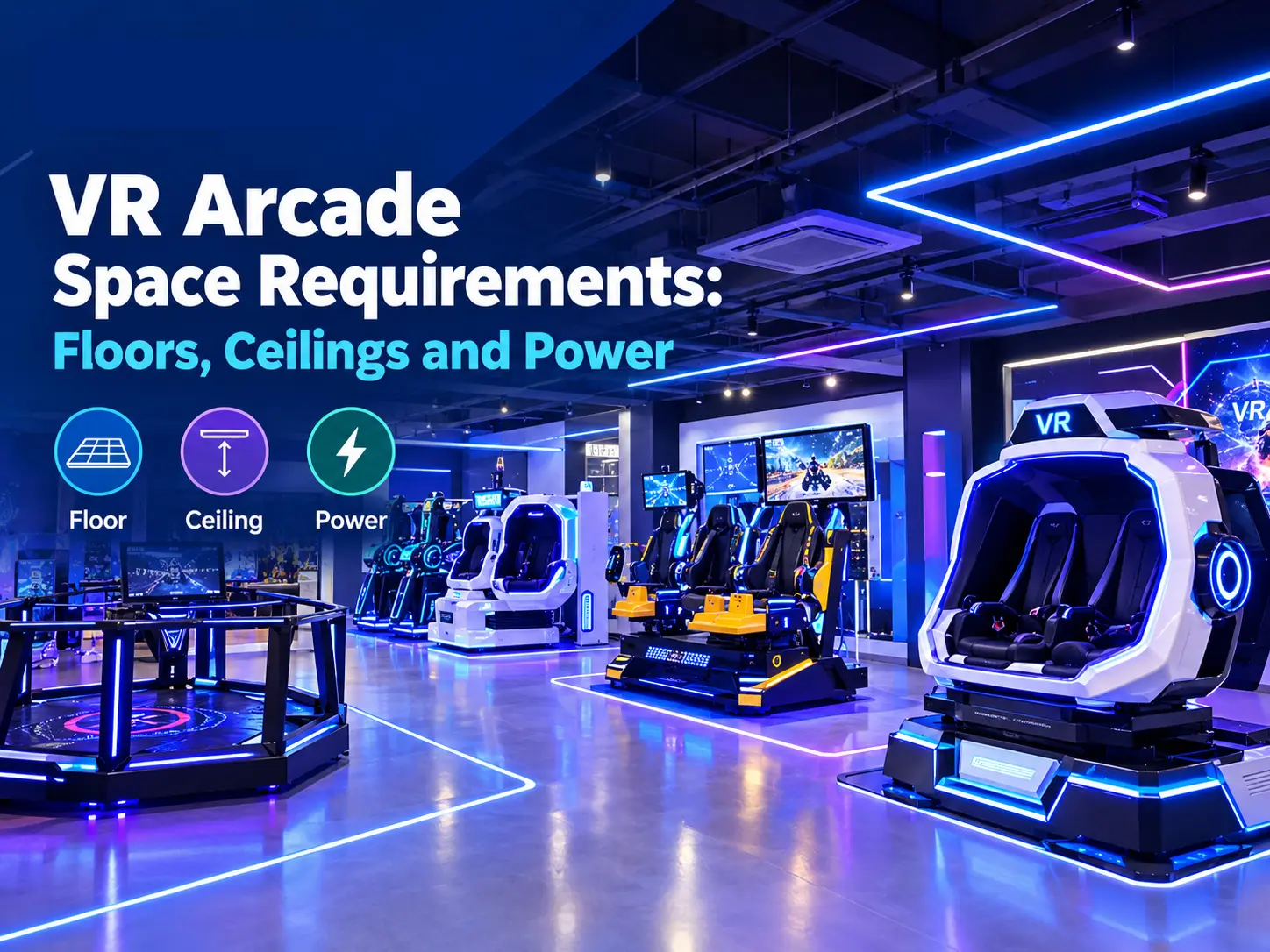
A seated motion pod occupies roughly one square metre of floor and draws 750 watts. A two-player paragliding unit occupies more than nine square metres and draws 7,000 watts. Those are the same price category on a catalogue page and completely different projects on a floor plan.
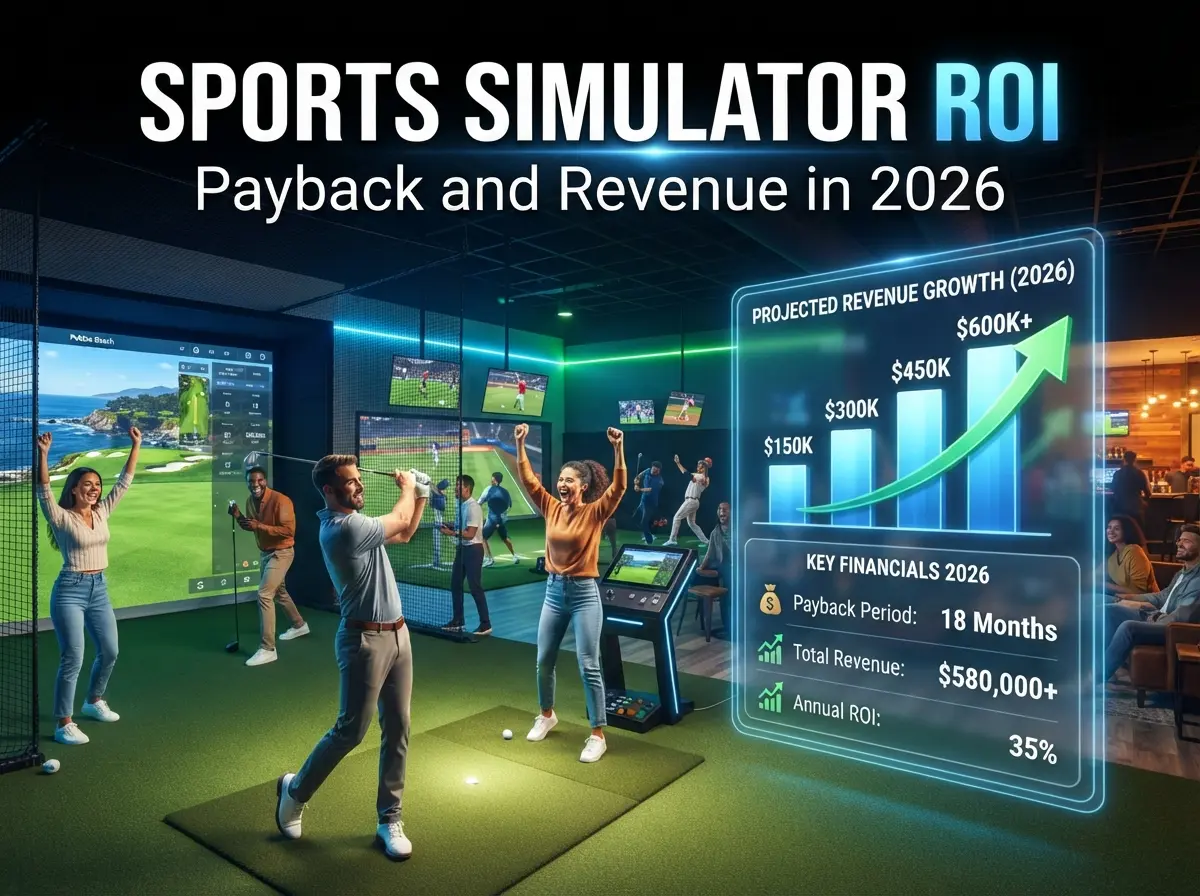
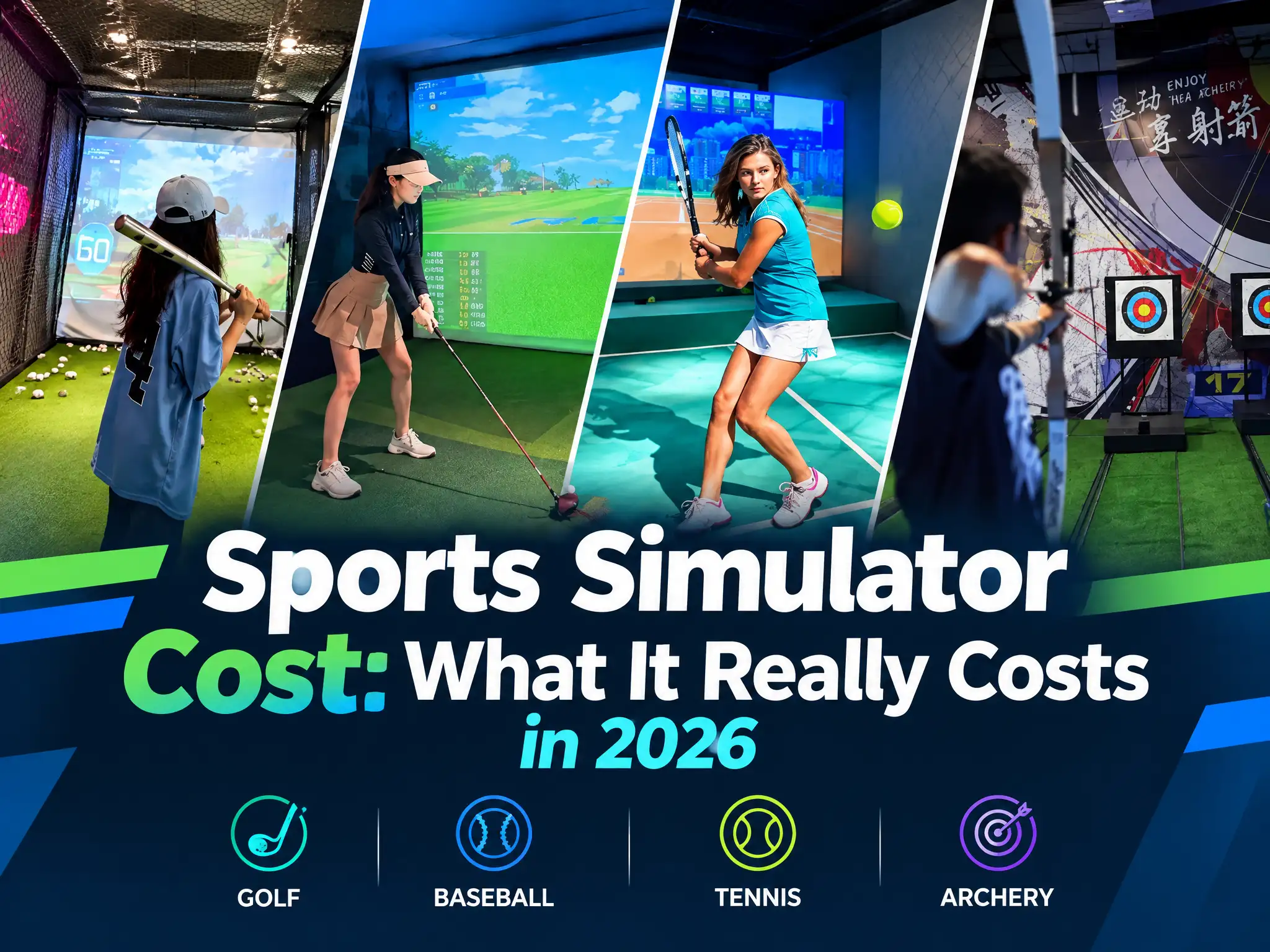
Sports simulation is also a unit price, and it is the category where a factory-direct quotation differs most from a venue-side one. Our export listings run from about USD 1,300 for a compact multi-player archery gallery to about USD 13,500 for a full training bay or lane set, FOB and with a minimum order of one unit. A venue-side figure for the same sport carries reseller margin, local installation and a service contract, which is why the two numbers describe the same machine at different points in the supply chain.
Mirror mazes are quoted per project. For early budgeting, a commercial maze runs about USD 400 to 800 per square metre of maze area, so a 100-square-metre maze falls in the region of USD 40,000 to 80,000 for the attraction itself, before freight, import duties, local installation and site work. Wall height matters as much as area: a maze with three-metre walls needs more material, stronger framing and more lighting than the same footprint with 2.4-metre walls.
One exclusion applies to every range above, and it is the item most often left out of a comparison. These are equipment figures. Freight, packing and duties, site preparation, installation labour and commissioning sit outside them, and in a shell unit rather than a finished building those items can approach the equipment cost itself. Two quotations built on identical equipment lists can therefore differ by a wide margin without either of them being wrong.
The categories we do not publish prices for
Laser mazes, activation arenas, push-button walls, interactive climbing walls and AR light games are configured to the venue in the same way a mirror maze is, so we do not publish list prices for them either. They are quoted against a layout. If one of them belongs in your plan, send the room dimensions and the number of players you want to handle at once, and you will get a configuration rather than a catalogue entry.
Matching the mix to your floor
Before choosing categories, know how much floor each one takes. The figures below are the areas we publish for our own systems, and they are the constraint that decides your mix.
Read the VR row carefully, because it is the one that misleads. A six-unit mixed VR room needs about 57 square metres once every machine has the clearance it requires, and that is before circulation, queueing and storage. A venue that budgets VR by unit count alone will find the floor area has been committed by the time the third unit is drawn.
The mirror maze row is deliberately unhelpful, and the reason is the same one that makes it unquotable. A maze can be designed for a compact mall unit or for a large FEC hall, so there is no minimum to publish.
What there is instead is a list of things to send for a layout: room dimensions, ceiling height, entrance and exit positions, floor type, whether the floor can be drilled, available electrical supply, and the delivery route into the building. That delivery route is the item most often left out and most likely to cause a delay, because mirror panels and structural components have to physically fit through the doors, corridors and lifts on the way in.
What to buy first
The four categories differ in how quickly they start earning, and that matters more than which one has the best margin on paper. This is the sequence we would run for a venue that is opening rather than expanding.
The logic is not that the later categories are worse. It is that the later categories take longer between decision and revenue, and a venue that opens with the first two is trading while the last two are still being manufactured.
One sequencing warning. Power and ceiling height are shared constraints across the VR and sports simulation categories, and both are cheaper to resolve before the first fix than after. If your tenant space has a soffit lower than about three metres at any point over the planned play area, settle the machine mix before you sign, not after.
Frequently asked questions
How much does family entertainment center equipment cost?
There is no single figure, because an FEC entertainment floor is a mix of categories priced on different bases. Interactive LED floor games run from about USD 800 to 2,500 per square metre, VR attractions from about USD 2,500 to 30,000 or more per unit, sports simulation from about USD 1,300 to 13,500 per bay FOB, and mirror mazes from about USD 400 to 800 per square metre quoted per project. Build the budget in four lines rather than one total.
What is the most expensive part of an FEC?
Usually the category you allocate the most floor area to, not the category with the highest unit price. A large interactive floor attraction starts around USD 40,000 and runs past USD 100,000, which is more than most single VR or simulation units. The larger point is that floor area, not unit price, decides which category dominates your capital budget.
Why do FEC equipment cost estimates differ so much between suppliers?
Because they are measuring different scopes. One figure may cover equipment only, another equipment plus freight and duty, another a turnkey installation including site work and commissioning. When two quotations give different totals for what sounds like the same project, ask which of those three each one represents before treating them as a disagreement.
Do I need a floor plan before getting an FEC equipment quotation?
For interactive floors and VR you can get a usable estimate from a machine list. For a mirror maze you cannot, because the panels are manufactured to your wall runs and the route is planned around your entrance and exit positions. Any supplier who quotes a firm mirror maze price before seeing a floor plan is giving you an early estimate rather than a project quotation.
How much space does an FEC entertainment floor need?
It depends on the mix. A six-unit VR room alone needs about 57 square metres once each machine has its clearance, before circulation, queueing and storage. Our published interactive floor bands run from 10 to 15 square metres for a small zone up to 50 square metres and beyond for a large attraction. A golf bay with its enclosure takes about 6 by 5 metres. Add your circulation and support space on top of whichever combination you choose.
Should I buy equipment directly from a manufacturer or through a distributor?
It depends what you are buying. For standardised unit-priced equipment such as simulation bays, a factory-direct quotation removes reseller margin, local installation and a service contract from the price, which is a large part of why supplier figures differ. For a project-based attraction such as a mirror maze, what matters more is whether the party quoting you controls the design, the panel production and the installation sequence, because those are where a maze goes wrong.
How long does it take to fit out an FEC entertainment floor?
The categories differ enough that a single schedule is misleading. Interactive floor games are the fastest to specify and install. Simulation bays are standard units and move quickly once power and floor are ready. VR needs ceiling height and electrical capacity confirmed first, which is where delays originate. A mirror maze needs design, drawing approval and production before shipping, so it should start earliest in the programme even though it is installed last.
What should I check before signing an FEC equipment contract?
Check the ceiling height at the lowest point over every planned play area, not the highest point in the room. Check whether the electrical capacity is available at the board rather than at the building entrance. Check that the quotation states what scope it covers, since an equipment price and a turnkey price for the same attraction are not comparable. And check who supplies spare parts and technical support two years from now.
Where to go next
If you have a floor plan, a ceiling height and an idea of which categories you want, send them and we will come back with a category-by-category budget for the room you actually have rather than a range for a room like yours. Our guides to interactive floor games cost, VR arcade machine costs, VR arcade space requirements, sports simulator cost and mirror maze cost cover each category in depth. Reach us through the contact page.