
A mirror maze is not the kind of product you can simply put on a standard price list.
Each one is designed around the actual space where it will be installed. The layout follows the room dimensions, entrance and exit positions, ceiling height, and other site conditions. As a result, two venues with similar floor areas can receive quotations that differ by tens of thousands of dollars.
If a supplier gives you a firm price before seeing a floor plan, treat it as a rough starting estimate rather than a reliable project quotation.
For early budgeting, a typical commercial mirror maze may cost around USD 400 to USD 800 per square metre of maze area, depending on the layout, wall height, mirror material, lighting, theme, and overall level of finish.
A 100-square-metre mirror maze, for example, may fall in the region of USD 40,000 to USD 80,000 for the attraction itself, before freight, import duties, local installation, and other site-related costs.
What Does the Price of a Mirror Maze Include?
The final cost of a mirror maze is not determined by floor area alone. Several parts of the project can significantly affect the quotation.
Mirror Panels
The mirror panels are usually one of the largest material costs, and buyers often underestimate how much they affect the final price.
The number of panels depends not only on the floor area but also on the wall layout and wall height. Taller walls require more material, stronger framing, and additional lighting to maintain the visual effect.
For example, two mirror mazes may occupy the same floor area, but a maze with 3-metre walls can require considerably more material and structural support than one with 2.4-metre walls.
The route itself also matters.
A simple layout with a few turns requires fewer panels and simpler construction than a maze with multiple false openings, mirrored doors, dead ends, and junctions designed to make several routes look identical.
That additional complexity improves the visitor experience, but it also increases the manufacturing cost.

Glass or Acrylic Mirrors
Commercial mirror mazes are commonly built with either glass mirrors or acrylic mirror panels.
Glass generally provides a cleaner reflection and can maintain its appearance well in dry, climate-controlled indoor environments. Acrylic is lighter, easier to transport, and more resistant to impact, which can be useful in family entertainment venues with children.
Neither material is automatically the best choice for every project.
Buyers should ask about:
- Mirror material
- Panel thickness
- Edge treatment
- Backing material
- Moisture protection
- Replacement panel availability
These details can affect both the initial price and the long-term durability of the attraction.
Frame and Structural Support
The structural frame is rarely visible in promotional photographs, but it plays a major role in the finished attraction.
Mirror panels need to remain properly aligned after years of visitors touching, leaning against, and moving through the maze.
The quotation can vary depending on:
- Frame material
- Frame thickness
- Base plate design
- Wall fixing method
- Floor conditions
- Whether the existing floor can be drilled
A cheaper structure may reduce the initial price, but poor alignment can quickly affect both the appearance and the mirror illusion.
Lighting and Effects
Lighting is not simply decoration in a mirror maze. It is part of the attraction design.
Poor lighting can make the mirrors too obvious and reduce the illusion. Good lighting is usually even, low-glare, and positioned carefully to enhance reflections without exposing the maze layout too clearly.
Additional effects may include:
- Colour-changing LED lighting
- Light corridors
- Themed lighting effects
- Decorative fixtures
- Interactive elements
These additions increase the number of fixtures, drivers, wiring components, and installation work required.

Theme and Decoration
Theme work is often the most variable part of a mirror maze quotation.
The same maze layout can be finished as a simple reflective attraction or developed into a fully themed experience with scenery, printed surfaces, props, decorative entrances, and themed exits.
The difference between a basic finish and a heavily themed attraction can be substantial.
For buyers working with a fixed budget, theme and decorative elements are often easier to adjust than the basic structure of the maze.
Optional Features
Additional features can also affect the final project cost.
Depending on the concept, these may include:
- Background audio
- Timers
- Scoring features
- Photo points
- Interactive effects
- Additional AV equipment
These features can improve the visitor experience, but they also introduce additional hardware, software, installation, and support requirements.
Why Don’t Mirror Mazes Have a Fixed List Price?
An arcade machine can be manufactured as a standard product, stored in a warehouse, and shipped when an order is placed.
A mirror maze works differently.
The attraction is normally designed around the customer’s location. Panels are manufactured according to the wall runs, the route is planned around the entrance and exit positions, and installation depends on the ceiling height, floor conditions, electrical access, and delivery route.
That is why commercial mirror mazes are usually quoted as individual projects rather than sold at one fixed price.
The USD 400 to USD 800 per square metre range is useful for early budgeting, but it is not a substitute for a quotation based on an actual layout.
Before comparing suppliers, make sure you understand exactly what their quoted price includes.
A single price without information about the maze area, wall height, panel specification, lighting, theme level, and destination is not enough to build a reliable project budget.

What Should a Mirror Maze Quotation Include?
Ask suppliers to provide a clear breakdown.
A quotation presented as one lump sum can be difficult to compare and may hide important exclusions.
| Quotation Item | What It Should Include | What to Check |
|---|---|---|
| Maze area and rate | Area in square metres, rate applied, and what the rate includes | Does it include panels, framing, lighting, and decoration? |
| Layout design | Route planning, panel layout, and project drawings | Will you receive drawings before production begins? |
| Mirror panels | Glass or acrylic, thickness, edge treatment, and backing | Is the material specification confirmed in writing? |
| Frame and structure | Panel frames, base plates, and fixing method | Is the fixing method suitable for your floor? |
| Lighting and effects | Fixtures, wiring, drivers, and controls | Is the voltage suitable for your market? Are spare fixtures included? |
| Theme and decoration | Scenery, printed surfaces, props, entrance, and exit treatment | Which items are standard and which are optional? |
| Control and AV | Audio, timers, scoring, and photo features | Are software updates and language options available? |
| Crating and packing | Protection for mirror panels during transport | Is export packing included in the quotation? |
| Freight | Port-to-port or door-to-door delivery | What Incoterm is being used? What destination charges may apply? |
| Installation | Installation supervision, crew, or full installation | Who is responsible for the work on site? |
| Spare panels and parts | Replacement mirrors, fixings, lighting components | Which spare parts should be ordered with the first shipment? |
| Warranty and support | Warranty coverage and technical support | Are the terms provided in writing? |
How Does the Price Change as the Maze Gets Larger?
Doubling the floor area does not always double the total project cost.
Some parts of the project, such as design work, electrical planning, crating, and installation preparation, contain relatively fixed costs. Because of this, increasing a small maze to a medium-sized attraction may not follow a simple square-metre calculation.
However, larger projects eventually require more panels, more structural material, more lighting, and greater transport capacity, which can increase costs more quickly.
Complexity can also matter more than size.
A relatively small maze with dense mirror work, multiple false openings, complicated junctions, and layered lighting can cost more than a physically larger maze with a straightforward route.
When comparing quotations, look at the layout drawings as carefully as the total price.
Two other factors can also affect the final budget.
Wall height changes the amount of mirror material, framing, and transport volume required.
Site access can also add unexpected costs. Narrow doors, staircases, service lifts, and difficult delivery routes may affect panel sizes, installation planning, and local labour requirements.
What Should You Send to Get an Accurate Mirror Maze Quote?
The quality of a quotation depends heavily on the information provided at the beginning of the project.
A photograph of the room is helpful, but it is not enough on its own.
For a more accurate quotation, send:
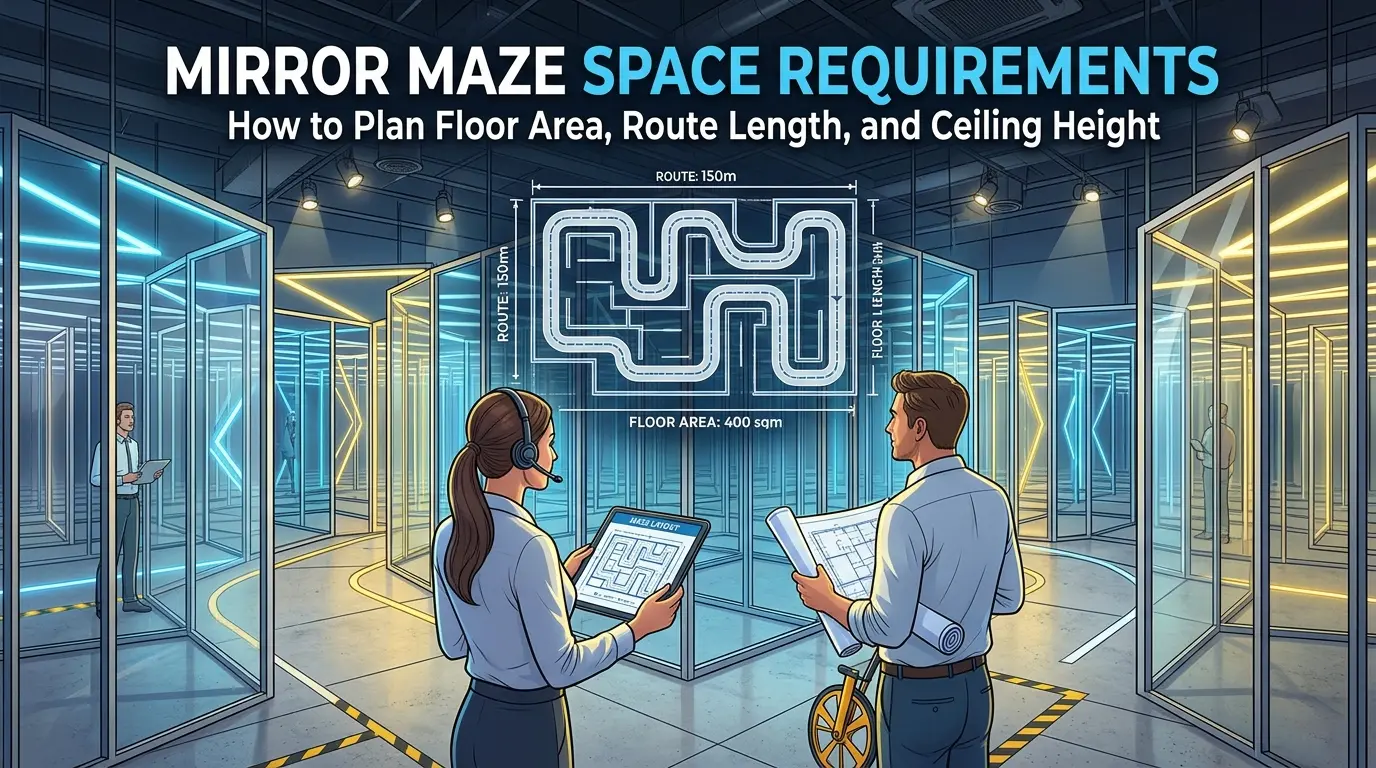
- A floor plan with dimensions
- Ceiling height
- Entrance and exit positions
- Queue area, if applicable
- Floor type
- Information about whether the floor can be drilled
- Available electrical supply
- Any beams, columns, pipes, or ceiling obstacles
- Delivery route into the building
The delivery route is particularly important.
Mirror panels and structural components must physically fit through doors, corridors, stairwells, and lifts. This is a detail that can cause unexpected delays if it is not checked before production.
The commercial information also helps refine the design and quotation.
If possible, provide:
- Venue type
- Target audience
- Preferred theme
- Destination country
- Port of arrival
- Other attractions planned for the same project
A supplier who asks for this information is not making the process unnecessarily complicated. They are trying to prepare a quotation based on the actual project rather than guessing.

How Profitable Is a Mirror Maze?
A mirror maze generally has lower operating costs than attractions with large motion systems or complex mechanical components.
There are no major motors or ride mechanisms running continuously, and routine maintenance is usually limited to cleaning, inspections, lighting maintenance, and replacing damaged panels when necessary.
However, profitability depends primarily on the venue.
For planning purposes:
Visitors per hour = (60 ÷ average walk-through time in minutes) × average group size
Revenue per hour = ticket price × visitors per hour
The actual result depends on factors such as:
- Visitor traffic
- Average walk-through time
- Group size
- Ticket price
- Opening hours
- Visibility within the venue
No supplier can accurately guarantee a payback period without understanding these numbers.
In many entertainment venues, a mirror maze works best as part of a wider attraction mix. It can encourage visitors to stay longer and purchase additional experiences rather than serving as the only reason people visit the location.
How to Compare Mirror Maze Suppliers
When choosing between suppliers, look beyond photographs and renderings.
Ask questions about the parts of the project that are not immediately visible.
Find out whether you are working directly with the manufacturer or through a trading company. Ask how replacement panels will be supplied in the future. Request drawings before production begins and confirm the material specifications in writing.
You should also confirm:
- Mirror material and thickness
- Frame specification
- Floor fixing method
- Lighting voltage for your market
- Installation responsibilities
- Spare parts availability
- Warranty terms
- Technical support process
The lowest quotation is not always the best option.
The important question is whether every supplier is quoting the same scope of work.
About AMA GAME
AMA GAME is the active gaming and amusement equipment brand of Guangzhou AMA Amusement Equipment Co., Ltd., a manufacturer founded in 2009.
We design and manufacture commercial mirror mazes based on our customers’ floor plans and project requirements. Customisation can include the maze size, layout, mirror material, lighting, visual effects, and themed decoration.
Alongside mirror mazes, AMA GAME also supplies active gaming equipment, interactive floor games, VR attractions, and sports simulation equipment for FECs, shopping malls, entertainment venues, and commercial projects.
You can see examples of our layouts on our commercial mirror maze page and in our project gallery.
Frequently Asked Questions
How much does a commercial mirror maze cost?
There is no single fixed price because a commercial mirror maze is usually designed around the customer’s floor plan rather than supplied as a standard product.
For early budgeting, a typical range is approximately USD 400 to USD 800 per square metre of maze area, depending on the layout, wall height, mirror material, lighting, and level of decoration.
A 100-square-metre mirror maze may therefore fall in the region of USD 40,000 to USD 80,000 for the attraction itself, before freight, import duties, local installation, and site work.
For an accurate figure, ask for a line-by-line quotation based on your actual drawings.
Why don’t suppliers publish fixed mirror maze prices?
Because the attraction is custom-designed.
Panels are manufactured according to the layout, the route is planned around the entrance and exit, and the installation method depends on the site conditions.
A published price without information about the area, wall height, layout complexity, material specification, and destination would only be a rough estimate.
Project-based quotations are therefore common for commercial mirror mazes.
What increases the cost of a mirror maze the most?
Floor area, wall height, and route complexity are major factors because they determine the amount of mirror material, framing, and lighting required.
Theme and decorative work can also significantly affect the budget. The same maze footprint can be finished as a simple reflective attraction or developed into a fully themed experience with scenery, props, lighting effects, and designed entrance and exit areas.
How much space does a mirror maze need?
There is no single minimum size because the layout can be designed around the available space.
Mirror mazes can be developed for compact mall units as well as larger FEC and entertainment venues.
For a layout proposal, provide the room dimensions, ceiling height, and entrance and exit positions. This allows the maze to be designed around the actual space rather than forcing a standard layout into the venue.
Is a mirror maze profitable?
It can be, but profitability depends more on the venue than on the attraction itself.
Operating costs are generally relatively low, so the financial result is mainly influenced by visitor traffic, walk-through time, group size, ticket price, and opening hours.
In many locations, a mirror maze performs best as part of a wider attraction mix that encourages visitors to stay longer and purchase multiple experiences.
How long do mirror maze manufacturing and installation take?
The schedule depends on the size of the project, drawing approval, level of theme work, production requirements, shipping, and site readiness.
Before placing an order, ask for a written schedule covering:
- Layout and drawing approval
- Production
- Packing and crating
- Shipping
- Site preparation
- Installation
You should also confirm who is responsible for each stage.
What information is needed for an accurate mirror maze quotation?
The most useful information includes a floor plan with dimensions, ceiling height, entrance and exit positions, floor type, available electrical supply, venue type, target audience, preferred theme, destination country, and port of arrival.
If possible, also provide details about the delivery route into the building.
With this information, a manufacturer can prepare a layout concept and a detailed project quotation rather than relying on a broad estimate.
Can a mirror maze be customised for our venue?
Yes.
Commercial mirror mazes can be customised according to the available space and project requirements.
Customisation may include:
- Maze size and layout
- Mirror material
- Wall height
- Lighting and visual effects
- Theme and decorative finish
- Entrance and exit design
For distributors and project contractors, OEM and ODM options may also be available for branding and market-specific configurations.
If you already have a floor plan, send it through our contact page. We can review the space and prepare a project-based layout and quotation.