Short answer: a family entertainment center business plan is decided by the building long before it is decided by the spreadsheet. Ceiling height, column spacing, floor loading and power capacity determine which attractions you can install — and those are the four things you cannot change after the lease is signed. Write the plan around the site you can actually lease, then let the financial model follow the floor plan, not the other way round.
Most FEC business plans fail in the same place: they are written as a funding document first and an operating document second. Investors read them and see a revenue forecast. Operators read them a year later and discover the anchor attraction does not fit under the ceiling, or that the power supply cannot run it.
This guide sets out the sections a family entertainment center business plan needs, the order to decide them in, and the numbers you should be able to defend before you commit to a lease.
The five decisions that must come before the financial model
Everything else in the plan is downstream of these:
- Format — is this an anchor-attraction venue (one big draw, short dwell time) or a mixed venue (multiple smaller attractions, longer dwell time)?
- Building constraints — clear ceiling height, column grid, floor loading, available power, and access for equipment delivery.
- Attraction mix — which categories, how many units of each, and how they are positioned relative to each other.
- Throughput — how many paying players per hour the floor can physically process at peak.
- Pricing model — per-play, timed admission, or unlimited-play wristband; and how parties and events sit alongside it.
If any of these five are still open questions, the revenue forecast below them is a guess.
What each section of the plan has to answer
Step 1 — Define the format before the equipment list
The single most useful decision in an FEC business plan is what kind of visit you are selling.
- Anchor-attraction format. One dominant experience carries the venue. Dwell time is short, ticket price is higher, and the floor plan must protect the anchor’s footprint and sightlines. Interactive floor games and large-format sports simulators are typical anchors because they convert open floor area into gameplay without a machine per player. See Active Gaming for how this category is specified.
- Mixed-format venue. Several mid-size attractions share the floor — a simulator bay, a VR zone, a mirror maze, plus redemption or soft play. Dwell time is longer and revenue per visit is spread across more touchpoints, but circulation and staffing complexity rise sharply.
Neither format is better. They fail differently: anchor venues fail when the anchor is not distinctive enough to justify a trip, mixed venues fail when the mix has no clear lead attraction and the visitor has no reason to choose you over the competing centre two kilometres away.
Write down which one you are building, and make the rest of the plan consistent with it.
Step 2 — Work backwards from the building, not from the wish list
Before the plan goes to an investor or a landlord, confirm these five things on site:
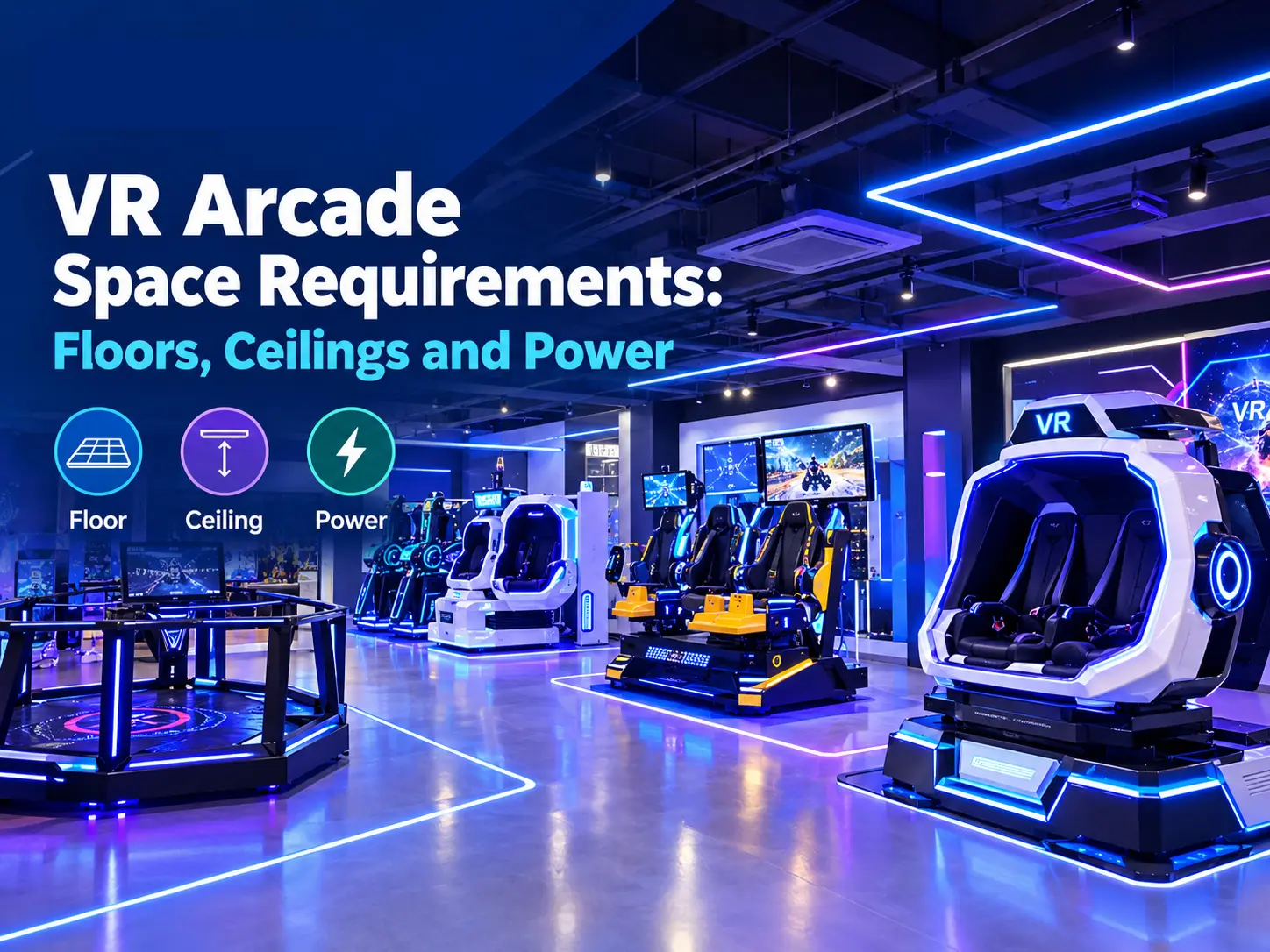
- Clear ceiling height — the tallest attraction plus its structure, lighting and any safety clearance. VR and simulator attractions are usually governed by this, not by floor area. Our breakdown of VR arcade space requirements covers floors, ceilings and power in detail.
- Column grid and floor plate — columns break up both circulation and the sightlines an anchor attraction depends on.
- Floor loading — heavy simulator bases and multi-player platforms are point loads, not evenly distributed weight.
- Power capacity and distribution — total available supply, and where the distribution board can realistically be extended. This is often the slowest and most expensive building change.
- Delivery access — door widths, lift dimensions and any time-of-day restrictions on moving large equipment through a mall.
A family entertainment center business plan that lists an attraction mix the building cannot support is not ambitious — it is unfundable, because any experienced reviewer will spot it.
Step 3 — Build the attraction mix as a portfolio, not a shopping list
Allocate capital in three tiers:
Two rules that hold across venue sizes:
- Do not average your capex. A venue where every attraction costs roughly the same usually has no anchor, and no anchor means no reason to travel.
- Buy capacity, not units. Ten single-player machines and one twelve-player interactive floor can occupy similar space and cost similar money, but only one of them processes a birthday party in a single session. Throughput, not unit count, is what pays rent.
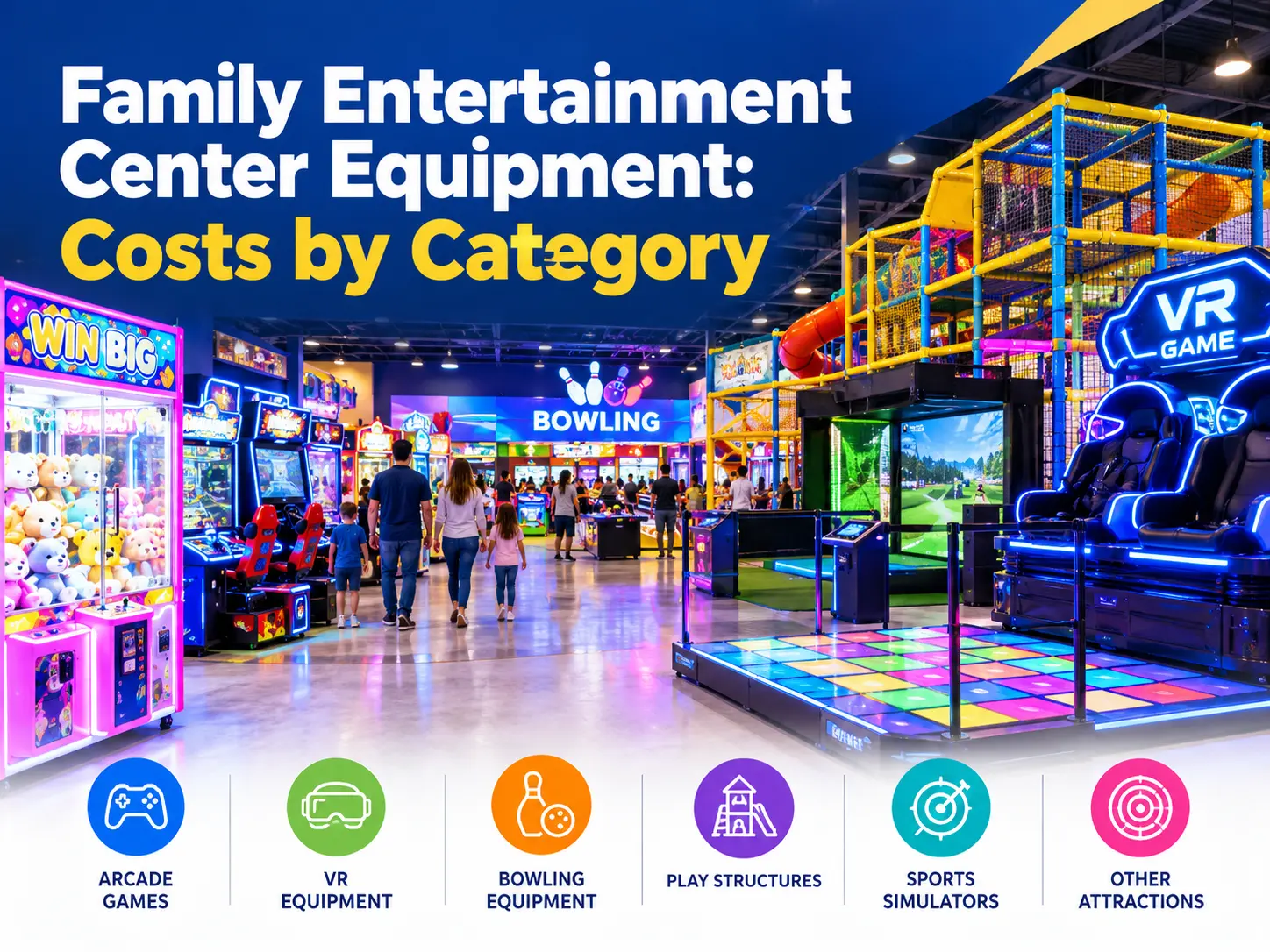
If your site already has a defined footprint, start from our FEC equipment cost by category breakdown, which budgets the floor by category rather than as a single lump sum.
Step 4 — Model revenue from throughput, and be able to show the arithmetic
The most common forecasting error in FEC business plans is multiplying a visitor headcount by an average spend. Peak-hour capacity is the real constraint on an entertainment floor, so build the model from sessions:
Hourly revenue capacity
  = players per session
  × sessions per hour
  × utilisation (%)
  × price per player

Then:  × peak hours per week  →  peak revenue
       + off-peak revenue  +  parties and events  +  F&B  +  retail
       − operating costs  =  contribution before fixed costs
Use it as a template and replace every input with figures from your own quotes and your own local pricing research. An illustrative version of the same formula — with all inputs as placeholders, not benchmarks — looks like this:
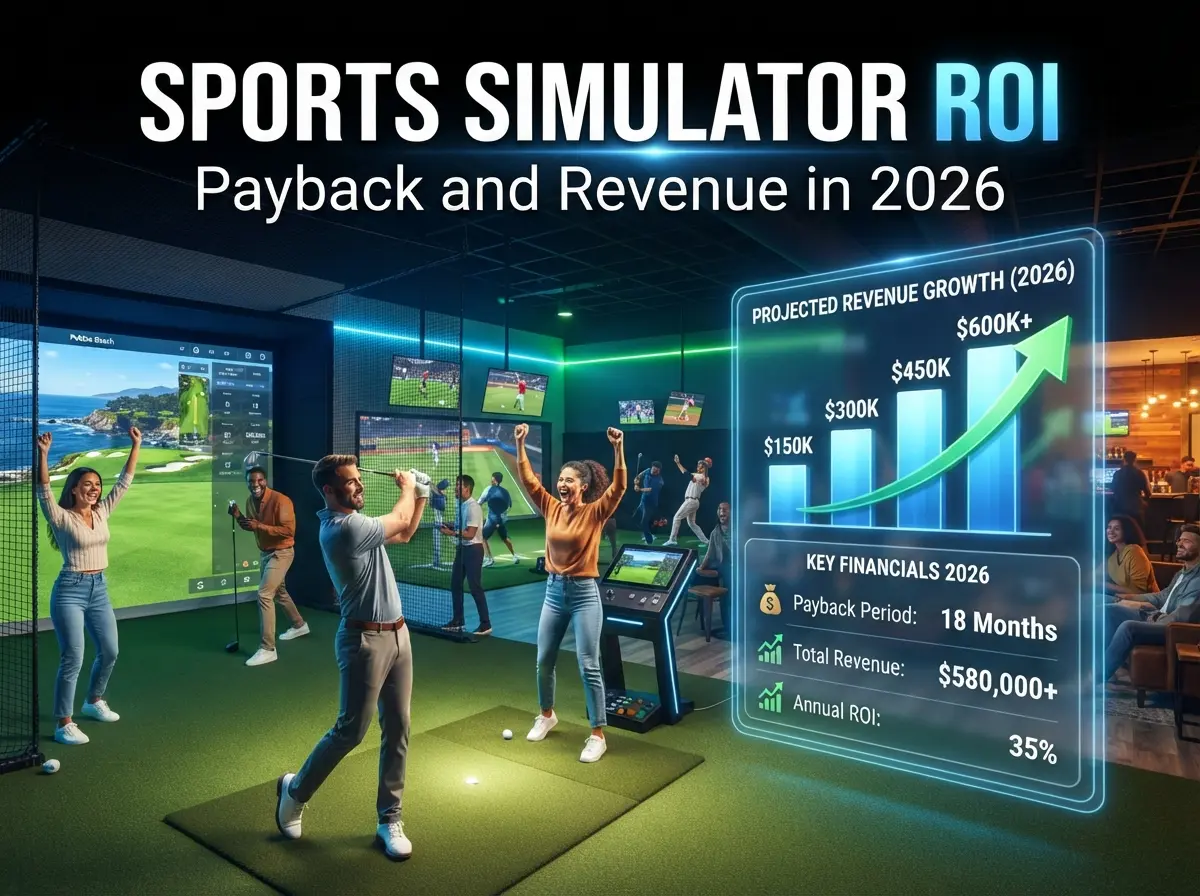
The value of writing it this way is not the output — it is that every assumption becomes visible and challengeable. When utilisation or price moves, you can show precisely what happens to payback. Our sports simulator ROI analysis uses the same logic on a single attraction.
Add the downside case. A plan that only works at plan-level attendance is not a plan. Model attendance 30% below forecast, and state what you cut first: filler capex, then staffing hours, then opening days.
Step 5 — Cost the operation, not just the equipment
Three operating lines get underestimated in almost every FEC plan:
- Peak staffing. Interactive and simulator attractions need a host at peak — to run sessions, brief players and manage queues. Budget peak shifts properly; the cost of one understaffed Saturday is a family that does not come back.
- Maintenance and spares. Projector lamps, sensors, controllers, padded surfaces and moving parts are wear items. Budget an annual consumables line from day one, and confirm spare-part lead times with your supplier before opening.
- Software and content. Attraction content ages. If a system cannot be updated with new games, the venue’s repeat-visit engine stalls — check update policy and cost at the procurement stage, not after.
Step 6 — Specify equipment sourcing before you commit capex
The sourcing section is where a family entertainment center business plan either becomes credible or falls apart. Cover these points explicitly:
- Manufacturer vs trading company. Ask who actually builds the machine, and ask for the factory, not just the catalogue.
- Certification. Commercial venues generally require CE, FCC, UL, RoHS or equivalent depending on market, plus ISO 9001 quality management. AMA GAME manufactures under these standards, which matters when your landlord, insurer or licensing authority asks.
- Customisation scope. If your concept depends on a unique attraction, confirm what can be customised — hardware, software, appearance and branding — and what cannot. For VR arcade sourcing we set out the four checks to complete before paying a deposit.
- Lead time and installation. Build production and shipping time into the opening date, and confirm who supervises installation and commissioning.
- After-sales. Warranty terms, remote support, spare parts availability and engineer response time.
- Selection by venue type. The right simulator for a mall unit is not the right one for a dedicated arcade — see how to choose commercial sports simulation equipment for different venues.
The appendix is what makes the plan fundable
Attach, at minimum:
- Site survey notes with measured ceiling height, column positions, floor loading and power capacity.
- A scaled floor plan showing attractions, circulation and queue areas.
- Written quotations, not verbal ranges, for the anchor and supporting attractions.
- Supplier verification evidence: factory details, certifications, references from comparable venues.
- A downside financial case, alongside the base case.
Reference projects in comparable markets are the fastest way to make this section concrete — see our project case studies.
Five mistakes that sink FEC business plans
- Planning attractions before the building survey. Constraints found late become change orders.
- No clear anchor. A mix of equally weighted attractions gives the visitor no reason to choose you.
- Forecasting from headcount instead of throughput. Capacity, not demand, usually caps revenue.
- Buying on unit price. The cheapest machine with no spares and no content updates is the most expensive one you will own.
- No downside case. Reviewers trust plans that show what happens when the forecast is wrong.
Frequently asked questions
How long should a family entertainment center business plan be? Long enough to cover the nine sections above and short enough that an investor reads all of it. Depth belongs in the appendix — site survey, floor plan, quotations and supplier evidence — rather than in the main narrative. A plan of roughly 20 to 35 pages plus appendices is typical for a single-site venue seeking finance.
What should I decide first when writing a family entertainment center business plan? The format, then the building constraints. Whether you are building an anchor-attraction venue or a mixed venue changes the floor plan, the capex split and the staffing model. Both depend on what the site can physically hold, so the site survey should come before the attraction list.
Should I order equipment before the business plan is finished? No. Equipment lead times are a real planning constraint, but ordering before the floor plan and the sourcing checks are complete is how venues end up with machines that do not fit, cannot be serviced locally, or cannot be updated. Confirm constraints and supplier support first, then commit capex.
How much does FEC equipment cost? There is no single figure, because an FEC floor is budgeted by category rather than as one total: interactive floor games are priced by area, simulator attractions per bay or machine, and VR per unit and configuration. Our breakdown of FEC equipment costs by category sets out how each category is priced and what drives the number.
Where can I get equipment quotations and a floor plan review? Manufacturers who supply commercial venues will normally review your floor plan and propose an attraction mix before quoting. Send your site dimensions, ceiling height and target audience to our project team and we will come back with an equipment recommendation and an itemised quotation. General specification questions are answered in our FAQ.
Start with the site, not the spreadsheet
AMA GAME supplies active gaming equipment — interactive floor games, sports simulators, VR arcade systems and mirror maze attractions — to FECs, shopping malls and amusement operators in more than 150 countries, with OEM and ODM customisation and factory-direct production in Guangzhou.
If you are at the planning stage, send us your floor plan and building constraints. We will tell you what fits, what does not, and what the equipment will cost — before you sign the lease.
Get a project quote → | See project case studies | About AMA GAME