Straight answer: in 2026, a dedicated VR arcade with six machines costs roughly 80,000to80,000to130,000 to open. If you already run an arcade, a family entertainment center, or a mall space and just want to add a VR zone, you can do it for 25,000to25,000to50,000. If you are dreaming of a destination-scale VR experience center with cinema attractions, plan on $200,000 and up.
The reason the range is that wide is not that nobody can count. It is that “VR arcade” describes three genuinely different businesses, and they need different amounts of money, space, and patience. This article walks through all three, shows you where every dollar goes, and — more usefully — shows you which mistakes quietly kill venues that did their machine research perfectly.
If you have not priced machines yet, our 2026 VR arcade machine price guide covers the equipment side model by model. This article is about everything around the machines, because that is where the surprises live.
The Machines Are Not the Expensive Part
First-time operators almost always build their budget backward: they total up the machine prices, add a buffer, and call it their startup cost. In a typical dedicated VR arcade, that is wrong by roughly half.
Delivered and installed equipment usually ends up being 40–55% of total startup capital. The rest goes to things no machine invoice ever mentions: electrical and network work, flooring and lighting, queuing areas and furniture, signage, a booking and POS system, opening marketing, licenses and insurance — and, most often forgotten, three to six months of operating reserves so the business survives while revenue ramps up.
A practical rule used by operators who have done this before: take your equipment budget and multiply by 1.8 to 2.2 to get a realistic total for a from-scratch venue. Budget fixed at 60,000?Thenthemachinelistshouldholdroughly60,000?Thenthemachinelistshouldholdroughly28,000–33,000ofhardware,not33,000ofhardware,not50,000 — a $50,000 machine order with no money left for the room around it is how venues open half-finished.
For the machine-price side of that math, model by model, our detailed breakdown of VR arcade machine prices in 2026 has you covered.
Three Ways to Open a VR Arcade, Three Very Different Budgets
Model A: add a VR zone to a venue you already run. You have an arcade, a bowling alley, an FEC, or a mall entertainment floor. You add two to four compact VR stations, usually 40–80 m² of new or repurposed space. Equipment lands at 15,000–15,000–30,000 delivered, and the whole incremental project runs 25,000–25,000–50,000. Your existing staff absorbs most sessions, so payroll barely moves. Because rent is already being paid by the rest of the floor, the VR stations are pure marginal revenue. This is the lowest-risk way into VR, and it usually pays for itself in 12–20 months. The catch is execution: the zone has to be visible and staffed, or you end up with four expensive machines in a corner that people walk past.
Model B: a standalone arcade with five to eight stations. The classic “VR arcade” most guides are really describing: a mix of single-seat simulators, one or two multiplayer shooting attractions, and something social, in a high-foot-traffic retail spot. Figure 100–180 m², 30,000–30,000–55,000 of delivered equipment, 80,000–80,000–130,000 all in, and two to four staff. Payback lands somewhere between 18 and 30 months. This is the model where rent and foot-traffic conversion decide everything, so the rest of this article uses it as the working example.
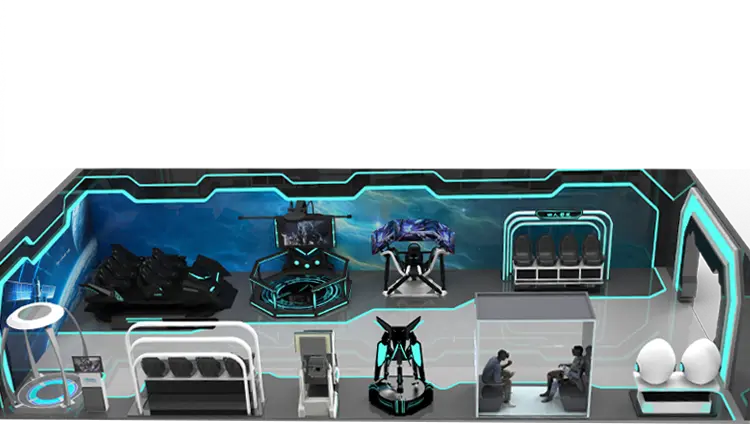
Model C: a destination VR experience center. Ten-plus stations, arena-scale or cinema-scale attractions, real party and corporate-event infrastructure. From 300 m² up, 100,000–100,000–250,000+ of equipment, 200,000–200,000–450,000+ total, six to twelve staff including event coordination. Payback is 24–48 months, and it only makes sense where the local population and tourist draw can actually fill a destination — validate the group and events volume in your trade area before committing, because walk-in singles alone will not carry it.
Where the Money Actually Goes
Here is the working budget for a Model B venue with six stations. Figures are planning estimates in USD for 2026; your country, city, and labor market will move them, but the proportions hold up.
| Budget line | Low | High | What it covers |
|---|---|---|---|
| VR equipment (FOB) | $24,000 | $42,000 | 2 egg chairs, 2 racing simulators, 1 multiplayer shooter, 1 social/dance machine |
| Freight, duties, installation | 25–35% on top of FOB | — | Shipping, import duty, rigging, commissioning |
| Venue preparation | $15,000 | $30,000 | Power, network, HVAC, flooring, lighting, signage, queuing area |
| POS, booking, sound | $1,500 | $4,000 | Counter system, online booking, audio |
| Opening marketing | $2,000 | $5,000 | Launch event, social content, local ads |
| Licenses, permits, insurance, year one | $2,500 | $6,000 | Amusement permits, liability cover |
| Working capital, three months | $18,000 | $30,000 | Rent, payroll, bills while revenue ramps |
| Total | $80,000 | $130,000 |
Two things stand out. Equipment plus getting it into the building is about half the total, which is exactly the 45% rule from earlier. And the operating reserve alone — 18,000–18,000–30,000 — is bigger than many first-timers budget for everything except machines. A VR arcade does not hit target revenue in month one. It usually does not in month three. The reserve is the difference between a slow start and a dead business.
Space Costs More Than You Think
Most people price the machine’s footprint and forget the room around it. A compact VR egg chair occupies about two square meters. A safe, presentable station needs its footprint plus clearance on the active side plus its share of the walkway — in practice, plan 8–12 m² per compact station and 15–25 m² per multiplayer or cinema attraction, counting queuing and shared space. A six-station Model B venue ends up needing roughly 100–140 m² of usable floor before landlord circulation requirements.
Then do the rent math the way landlords do: revenue per square meter. Estimate your realistic monthly gross and divide by total leased area. A healthy VR entertainment zone in a mid-tier retail location runs roughly 120–120–250 per m² per month. If the lease you are looking at forces you above what comparable venues in the same building achieve, the machines were never the problem — the lease is. Ask for a rent-free fit-out period, and make sure the lease says who pays for the extra HVAC tonnage a windowless VR room needs. That line alone surprises a lot of operators.
The Bill You Pay Every Month: Software and Content
Hardware is a one-time decision; content is a monthly habit. Commercial VR machines come with an included game library — commonly 10 to 60 titles depending on the supplier — and that library is the product your customers are actually buying. Budget 150–150–500 per month to keep it fresh: new titles, content packs, updates.
Before you buy, ask the supplier three questions: how many games are actually included, whether future updates cost extra, and whether the machine accepts new content at all. Two machines with identical-looking hardware can be completely different businesses if one gets new games and the other is frozen at whatever shipped in the crate.
Do not treat this line as optional. A customer who has seen the whole catalog has no reason to come back. Operators who refresh even two titles a month consistently report better revisit rates than the ones who do not — content is retention, and retention is the difference between a weekend spike and a steady business.
The Operating Costs Nobody Warns You About
Four recurring costs kill more VR arcades than machine failure does.
Maintenance and downtime. Motion platforms, joysticks, sensors, and cables take real abuse from real customers. Budget 5–8% of equipment value per year for repairs and spare parts, and keep basic spares on site from day one. Then plan for the real cost: capacity. A six-machine venue with no spare has no buffer — one unit down is 17% of throughput gone on your busiest Saturday. One spare unit, or a machine that can cover two roles, is often cheaper than the lost weekend revenue.
Power, network, and heat. Motion platforms and projectors draw real current, and a windowless VR area needs serious HVAC. Six-station venues typically report 400–400–900 a month in electricity plus business-grade internet for content, updates, and booking. Some landlords charge separately for that HVAC load — confirm it before you sign, not after.
Insurance. Amusement-equipment liability is priced on risk, not square footage. Go to a broker who specializes; 1,500–1,500–4,000 a year is typical for a small US venue. Operating uninsured to save money is the worst trade in this business — one injury claim can exceed your entire startup budget.
Staffing and seasonality, together. Staff must run sessions, give safety briefings, sanitize between players, and reset hardware — and they must do it fast, because peak hours are when you earn. But peak hours are not every hour. School holidays and weekends spike; a Tuesday afternoon in term time can be nearly empty. If your model assumes flat daily revenue, it is wrong by design. Schedule to the peaks, market to fill the valleys, and never confuse average traffic with weekend traffic.
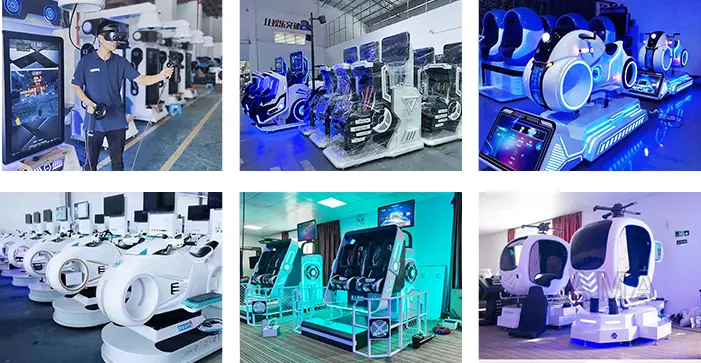
How a VR Arcade Makes Money
Four revenue streams, in order of importance for most venues.
Per-session and time bundles are the core. Typical pricing is 8–8–15 for a 10–20 minute session, or time bundles like 30 minutes on any machine for 20–20–30. Bundles are the better model: simpler to bill, encourages trying several machines, and lifts the average ticket. Per-play pricing suits single-seat simulators in add-on zones.
Parties and group bookings are your profit engine. Birthday parties, school groups, corporate events price at 25–25–45 per head with a minimum group. A six-station venue can run a twelve-kid party through multiplayer and single-seat attractions in two hours at several times the walk-in yield. Venues that cannot host parties — no space, no process, no staff for it — leave the most profitable hours of the week on the table.
Memberships and punch cards convert local regulars and flatten the weekday trough. A healthy small venue pushes 20–35% of sessions through repeat-purchase mechanisms by month six.
Ancillary sales — drinks, snacks, score printouts, leaderboard prizes — add margin on top. And if you are Model A inside an FEC, remember the machines’ real job may be increasing overall dwell time and spend across your whole floor, not carrying a standalone P&L.
A Six-Machine Store, Worked Through the Numbers
Rather than give you a vague “you can earn $X,” here is a concrete model you can rebuild with your own numbers. It is illustrative — a planning tool, not a promise.
Assume six stations, open ten hours a day, seven days a week. Weekdays bring roughly four paid sessions per station; weekends bring about eighteen, because weekends are when families and groups come out — weekends end up carrying about two-thirds of weekly sessions.
With an average realized price of $11 per session after blending single plays and bundled packages, the business would generate roughly 1,450 sessions per month, or about $16,000 in monthly revenue. Adding four to six party and group events could bring total monthly gross revenue to approximately $18,500–$20,000.
Now the monthly costs: rent including common-area charges 3,500–3,500–4,500; staff 4,000–4,000–5,500; content and software 150–150–400; maintenance reserve 200–200–400; utilities and internet 500–500–900; insurance 150–150–350; marketing 500–500–1,000; consumables and miscellany 300–300–500. Total operating cost lands around 10,000–10,000–13,000 a month.
The math: 5,500–5,500–9,000 in monthly EBITDA, a 30–45% operating margin before you pay yourself. Against a mid-range 100,000totalproject,thatleavesroughly100,000totalproject,thatleavesroughly4,000–$5,500 a month to actually pay the project back after an owner draw and taxes — an 18–28 month payback in the steady state.
Three levers matter more than any cost-cutting, in this order: realized price per session (raising it 10% adds roughly 1,900amonth),∗∗stationutilization∗∗(101,900amonth),∗∗stationutilization∗∗(101,600), and rent (every extra 1,000amonthis1,000amonthis1,000 gone). Notice that a venue which underprices by 20% needs about 25% more traffic to make the same money — traffic it will not have on a Tuesday afternoon. Price your time fairly, keep machines busy, and treat the lease as the fixed cost it is.
How Long Until You Break Even?
Realistic steady-state payback across the three models: 12–20 months for a Model A add-on zone, 18–30 months for a Model B standalone arcade, 24–48 months for a Model C experience center.
Payback is a range, not a promise, and the swing is mostly controlled by three things you can actually do something about: how many passers-by you convert into players (the biggest variable of all), whether you discount as a tactic or as a habit, and whether repeat customers have a reason to come back next month. Negotiate a rent-free fit-out, open with an event calendar already booked instead of hoping walk-ins appear, and size the first equipment list tightly — expand only after the numbers prove demand.
Think Through These Before You Spend
- Do the trade-area math. How many people pass the location weekly, and what conversion rate does the comparable venue in the same building actually achieve? Guesswork here is the most expensive guesswork in the project.
- Stress-test the lease. Can the business pay rent in your two worst months of the year, not just your best weekend?
- Model revenue per m² against the quoted rent before you sign anything.
- Size the equipment list to the total budget with the 1.8–2.2× rule — not the other way around.
- Confirm the content plan with the supplier: titles included, update policy and cost, spare parts, and language support for your market.
- Design for parties from day one, in the layout, the staffing plan, and the pricing sheet.
Planning figures are 2026 estimates based on published industry ranges and AMA GAME’s commercial VR export pricing. Validate with local rent, labor, tax, and traffic data before committing capital — every venue is different.
Ready to price the equipment side of your project? AMA GAME manufactures commercial VR arcade machines for venues worldwide. Tell us your country, available space, and target customers through the contact page for a configuration-matched quotation — or start with our VR arcade machine cost guide.
FAQ
What is the minimum cost to start a VR arcade?
The lowest realistic entry is adding two or three compact VR stations to an existing venue for 25,000–25,000–40,000 total, including delivery, installation, and a small marketing and reserve buffer. A freestanding venue costs more because rent, payroll, and fit-out cannot be avoided.
Is opening a VR arcade profitable?
A well-located six-station venue in the 80,000–80,000–130,000 startup range can model 5,500–5,500–9,000 in monthly EBITDA — a 30–45% operating margin — supporting an 18–28 month payback. Profitability hinges on realized price per session, station utilization, and rent, in that order.
How much does a single VR arcade machine cost?
Commercial VR machines typically range from about $2,500 for entry-level single-seat simulators to $30,000+ for large cinema-scale attractions. Most compact VR stations fall between $3,000 and $10,500, depending on the motion platform, screen configuration, and multiplayer capability. Our VR machine price guide breaks down the costs by machine type and model.
How much space do I need for a VR arcade?
Plan 8–12 m² per compact station and 15–25 m² per multiplayer or cinema attraction, including queuing and shared space. A six-station venue typically needs 100–140 m² of usable floor.
Do I need staff to run a VR arcade?
Yes. Even semi-automated venues need staff for session management, safety briefings, sanitization, and hardware resets. A six-station venue typically runs two to four full-time-equivalent roles, making payroll the second-largest monthly cost after rent.
What are the hidden costs of opening a VR arcade?
The commonly missed lines: content updates at 150–150–500 a month, maintenance at 5–8% of equipment value per year, utilities for motion platforms and HVAC, liability insurance, and three to six months of operating reserves for the ramp-up period.
Is a VR arcade a good business in 2026?
Location-based VR remains one of the faster-growing corners of the amusement industry — analysts put the location-based VR market above US$12 billion by 2027 (Transparency Market Research) as consumer VR adoption normalizes the experience. The verdict is local, though: it is a good business where rent per m² is sane, foot traffic converts, and content gets refreshed, and a bad one where any of those three fails.